Example 30 - Natural frequencies, mode shapes and natural frenquency map of a rigid rotor#
This example is based on Example 3.6.1, Example 3.7.1 and Example 3.7.2 from [Friswell, 2010].
import ross as rs
from ross.units import Q_
import plotly.io as pio
import numpy as np
import matplotlib.pyplot as plt
# Set default plot renderer
pio.renderers.default = "notebook"
Creating shaft element#
"""
Creates shaft elements with specified geometry and material properties.
"""
# Material Definition - Steel
steel = rs.Material(name="Steel", rho=7810, E=211e9, G_s=81.2e9)
# Shaft Geometry Parameters
shaft_length = 0.5 # [m]
shaft_diameter = 0.2 # [m]
num_elements = 5
element_length = shaft_length / num_elements
# Create shaft elements
shaft_elements = [
rs.ShaftElement(
L=element_length,
idl=0.0, # inner diameter (solid shaft)
odl=shaft_diameter,
material=steel,
shear_effects=True,
rotary_inertia=True,
gyroscopic=True,
)
for _ in range(num_elements)
]
Example 3.6.1#
Determine the natural frequencies and the mode shapes of the rigid rotor of Example 3.5.1 for the following:
(a) The horizontal and vertical support stiffnesses are 1.0 MN/m at bearing 1 and 1.3 MN/m at bearing 2 and the rotor spins at 4,000 rev/min.
(b) The horizontal and vertical support stiffnesses are 1.0 and 1.1 MN/m, respectively, at bearing 1, and 1.3 and 1.4 MN/m, respectively, at bearing 2. Note that the bearings are anisotropic. Obtain the natural frequencies and mode shapes when the rotor is stationary and also rotating at 4,000 and 8,000 rev/min.
Rotor assembly#
"""
Creates rotor assemblies for each case.
"""
# Bearing configuration for case (a)
bearings_a = [
rs.BearingElement(n=0, kxx=1.0e6, kyy=1.0e6, cxx=0), # Bearing 1
rs.BearingElement(n=5, kxx=1.3e6, kyy=1.3e6, cxx=0), # Bearing 2
]
# Bearing configuration for case (b)
bearings_b = [
rs.BearingElement(n=0, kxx=1.0e6, kyy=1.1e6, cxx=0), # Bearing 1 (anisotropic)
rs.BearingElement(n=5, kxx=1.3e6, kyy=1.4e6, cxx=0), # Bearing 2 (anisotropic)
]
# Create rotor assembly for case (a)
rotor_a = rs.Rotor(shaft_elements=shaft_elements, bearing_elements=bearings_a)
# Create rotor assembly for case (b)
rotor_b = rs.Rotor(shaft_elements=shaft_elements, bearing_elements=bearings_b)
# Plot rotor configuration for case (a), same as case (b)
rotor_a.plot_rotor().show()
Case (a) analyze#
"""
Analyzes case (a) from Example 3.6.1:
- Isotropic bearings (same stiffness in x and y directions)
- Rotor speed: 4000 RPM
"""
# Run modal analysis at 4000 rpm
modal_results_a = rotor_a.run_modal(speed=Q_(4000, "RPM"), num_modes=8)
# Print natural frequencies
print("\nCase (a) Results - Isotropic Bearings at 4000 RPM:")
print(f"Natural Frequencies: {Q_(modal_results_a.wd, 'rad/s').to('Hz'):.2f}")
# Plot mode shapes
print("\nMode Shapes:")
for mode in range(4):
modal_results_a.plot_mode_3d(
mode=mode, frequency_units="Hz", damping_parameter="damping_ratio"
).show()
Case (a) Results - Isotropic Bearings at 4000 RPM:
Natural Frequencies: [21.33 21.58 29.58 43.61] Hz
Mode Shapes:
Case (b) analyze#
"""
Analyzes case (b) from Example 3.6.1:
- Anisotropic bearings (different stiffness in x and y directions)
- Multiple rotor speeds: 0, 4000, and 8000 RPM
"""
# Analyze at different speeds
speeds = [0, 4000, 8000] # RPM
modal_results = []
# Print natural frequencies and plot mode shapes for each speed
for speed in speeds:
results = rotor_b.run_modal(speed=Q_(speed, "RPM"), num_modes=8)
modal_results.append(results)
# Print natural frequencies
print(f"\nCase (b) Results - Anisotropic Bearings at {speed} RPM:")
print(f"Natural Frequencies: {Q_(results.wd, 'rad/s').to('Hz'):.2f}")
# Plot mode shapes
print(f"\nMode Shapes at {speed} RPM:")
for mode in range(4):
results.plot_mode_3d(
mode=mode, frequency_units="Hz", damping_parameter="damping_ratio"
).show()
Case (b) Results - Anisotropic Bearings at 0 RPM:
Natural Frequencies: [21.50 22.46 35.84 37.34] Hz
Mode Shapes at 0 RPM:
Case (b) Results - Anisotropic Bearings at 4000 RPM:
Natural Frequencies: [21.44 22.43 30.26 44.39] Hz
Mode Shapes at 4000 RPM:
Case (b) Results - Anisotropic Bearings at 8000 RPM:
Natural Frequencies: [21.13 22.31 25.63 53.48] Hz
Mode Shapes at 8000 RPM:
Example 3.7.1#
Plot the natural frequency maps for rotor spin speeds up to 20,000 rev/min for the rigid rotor described in Example 3.5.1, supported by the following bearing stiffnesses:
(a) kx1 = 1.0 MN/m, ky1 = 1.0 MN/m, kx2 = 1.0 MN/m, ky2 = 1.0 MN/m
(b) kx1 = 1.0 MN/m, ky1 = 1.0 MN/m, kx2 = 1.3 MN/m, ky2 = 1.3 MN/m
(c) kx1 = 1.0 MN/m, ky1 = 1.5 MN/m, kx2 = 1.0 MN/m, ky2 = 1.5 MN/m
(d) kx1 = 1.0 MN/m, ky1 = 1.5 MN/m, kx2 = 1.3 MN/m, ky2 = 2.0 MN/m
Rotor assembly and campbell plot#
"""
Creates rotor assemblies for each bearing case and plot campbell diagram.
"""
bearing_configs = {
"(a)": [(1.0e6, 1.0e6), (1.0e6, 1.0e6)],
"(b)": [(1.0e6, 1.0e6), (1.3e6, 1.3e6)],
"(c)": [(1.0e6, 1.5e6), (1.0e6, 1.5e6)],
"(d)": [(1.0e6, 1.5e6), (1.3e6, 2.0e6)],
}
# Speed range (rad/s)
speed_range = np.linspace(0, Q_(20000, "RPM"), 100)
# Run Campbell diagram for each case
for case, ((kxx1, kyy1), (kxx2, kyy2)) in bearing_configs.items():
bearing1 = rs.BearingElement(n=0, kxx=kxx1, kyy=kyy1, cxx=0)
bearing2 = rs.BearingElement(n=5, kxx=kxx2, kyy=kyy2, cxx=0)
# Rotor Assembly
rotor = rs.Rotor(
shaft_elements=shaft_elements, bearing_elements=[bearing1, bearing2]
)
# Campbell diagram plot
campbell = rotor.run_campbell(speed_range=speed_range, frequencies=4)
campbell.plot(title=f"Campbell Diagram - Case {case}", frequency_units="Hz").show()
Example 3.7.2#
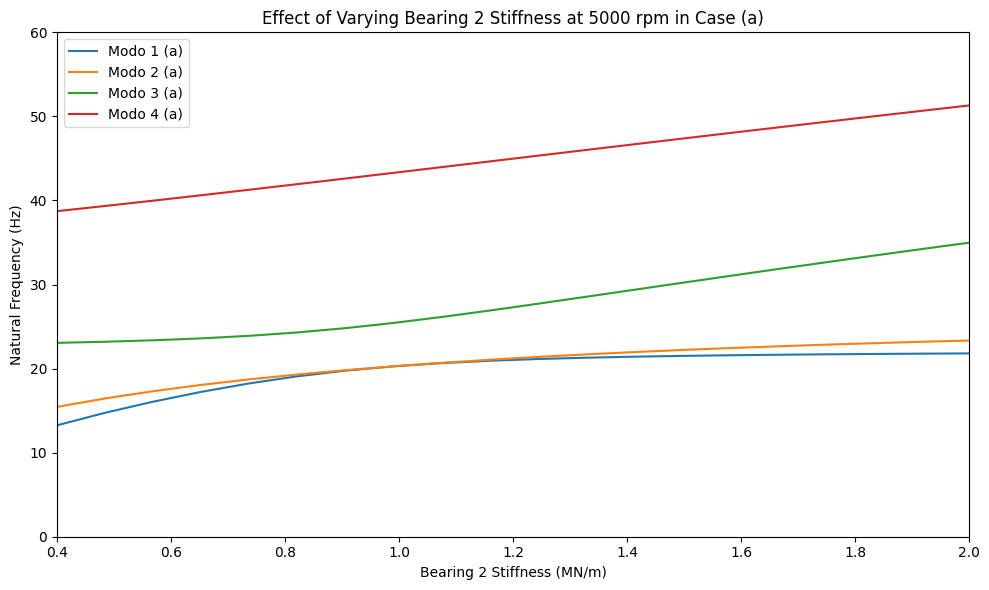
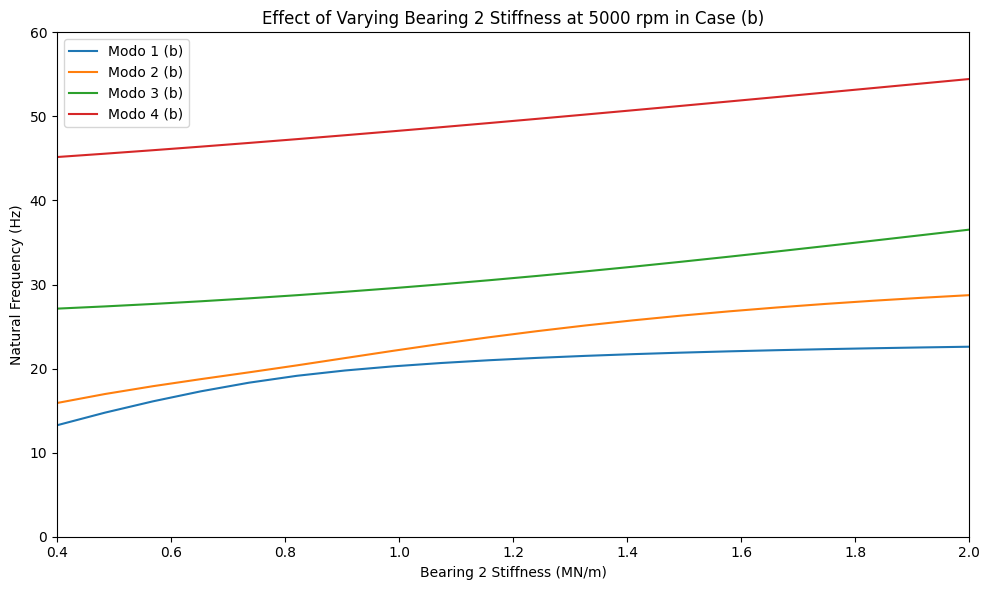
Determine the effect of varying the stiffness of bearing 2 for the rigid rotor as described in Example 3.5.1 for a rotor spin speed of 5,000 rev/min. Assume the bearing is isotropic and vary kx2 = ky2 in the range 0.4 to 2.0 MN/m.
The properties of bearing 1 are:
(a) kx1 = 1.0 MN/m, ky1 = 1.0 MN/m
(b) kx1 = 1.0 MN/m, ky1 = 2.0 MN/m
Rotor assembly and natural frequency maps#
"""
Creates rotor assemblies for each bearing case and plot natural frequency maps.
"""
# Rotor speed (rpm to rad/s)
rotor_speed = Q_(5000, "RPM")
# Stiffness range for Bearing 2 (MN/m -> N/m)
k2_values = np.linspace(0.4e6, 2.0e6, 20)
# Bearing 1 configurations
bearing1_cases = {
"(a)": (1.0e6, 1.0e6),
"(b)": (1.0e6, 2.0e6),
}
# Loop over bearing1 cases
for label, (kxx1, kyy1) in bearing1_cases.items():
modes = []
for k in k2_values:
bearing0 = rs.BearingElement(n=0, kxx=kxx1, kyy=kyy1, cxx=0)
bearing1 = rs.BearingElement(n=5, kxx=k, kyy=k, cxx=0) # Isotropic
rotor = rs.Rotor(
shaft_elements=shaft_elements, bearing_elements=[bearing0, bearing1]
)
modal = rotor.run_modal(speed=rotor_speed)
modes.append(modal.wn[:4]) # First two natural frequencies
# Plot setup
plt.figure(figsize=(10, 6))
modes = np.array(modes)
for i in range(4):
plt.plot(
k2_values / 1e6, modes[:, i] / (2 * np.pi), label=f"Modo {i + 1} {label}"
)
# Plot adjustments
plt.xlabel("Bearing 2 Stiffness (MN/m)")
plt.ylabel("Natural Frequency (Hz)")
plt.title(f"Effect of Varying Bearing 2 Stiffness at 5000 rpm in Case {label}")
plt.legend()
plt.xlim(0.4, 2)
plt.ylim(0, 60)
plt.tight_layout()
plt.show()